


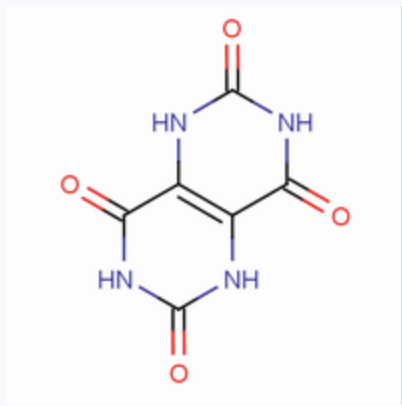

This compound is not a bulk chemical but a highly specialized, multifunctional organic building block based on a fused pyrimidine ring system. Its core value stems from its unique molecular structure.
1. Structural Features
Highly Symmetric Fused Ring System: Composed of two fused pyrimidine rings, forming a rigid planar conjugated structure, which imparts good thermal stability and potential photoelectric properties to the molecule.
Four Reactive Hydroxyl Groups: The four symmetrically distributed hydroxyl (-OH) groups provide multiple reactive sites for various functional group transformations such as esterification, etherification, and condensation, enabling the construction of complex molecules or polymers.
Rich Hydrogen Bond Donors/Acceptors: The carbonyl (C=O) and amine (N-H) groups in the molecule allow it to act as strong hydrogen bond donors and acceptors. This characteristic is crucial for self-assembly, supramolecular chemistry, and interactions within biological systems.
Amphiphilic Potential: Through chemical modification, different side chains (hydrophilic parts) can be introduced onto its rigid backbone (hydrophobic part), enabling the design of amphiphilic molecules with specific surface activities.
2. Technical Characteristics & Synthesis Methods
Synthetic Routes: Typically synthesized from barbituric acid or its derivatives through cyclization, oxidation, and other steps. The process requires precise control of conditions to obtain high-purity products.
High Purity Requirements: As an intermediate for pharmaceuticals and materials, it demands extremely high purity with strict limits on impurities such as heavy metals and residual solvents (often requiring pharmaceutical or electronic grade standards).
Versatile Platform Molecule: It serves as a "platform molecule" itself. Selective or complete modification of its four hydroxyl groups can yield a vast library of derivatives for various applications.
|
Item |
Target |
Purpose |
|
Purity (HPLC) |
≥99.0% |
Main active content |
|
Appearance |
White/light yellow powder |
Visual quality |
|
Water Content |
≤0.5% |
Stability control |
|
Heavy Metals |
≤10 ppm |
Safety compliance |
|
Residual Solvents |
Meet ICH standards |
Process safety |
-
Core Scaffold: The pyrimidopyrimidine structure serves as the core pharmacophore for many protein kinase inhibitors (especially those targeting key kinases in cell signaling pathways) and antiviral drugs.
-
Key Intermediate: Acts as a crucial advanced intermediate in synthesizing complex heterocyclic compounds with anticancer, anti-inflammatory, and antimicrobial activities.
-
Organic Semiconductors & Electronic Materials: Its rigid conjugated planar structure gives it potential for use in constructing electron transport or emissive layers in devices such as organic field-effect transistors (OFETs) and organic light-emitting diodes (OLEDs).
-
Metal-Organic Frameworks (MOFs): Can act as a multidentate organic ligand to assemble MOFswith specific pore structures and functions, used for gas adsorption, catalysis, or sensing.
-
Supramolecular Gels & Self-Assembly: Utilizes its strong hydrogen-bonding network to form supramolecular gels for soft matter materials or drug delivery carriers.
-
Chelating Agents & Fluorescent Probes: The N and O atoms in its structure can chelate specific metal ions. After modification, it can be used to develop fluorescent or colorimetric chemosensors for detecting metal ions or small molecules in environmental or biological samples.
Based on the above characteristics, this compound is primarily used in the following high-tech fields:
1. Pharmaceutical Chemistry & Bioactive Molecules
2. Functional Materials Science
3. Analytical Chemistry & Sensing