


Structure and Nomenclature
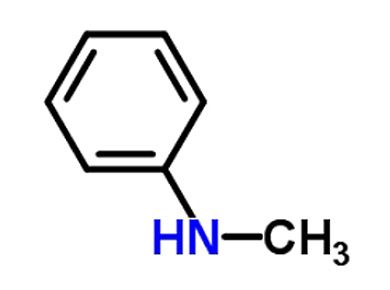
The prefix "N-" is crucial in the nomenclature. It indicates that the methyl group (-CH₃) is directly attached to the nitrogen atom, not to a carbon atom on the benzene ring. If the methyl group were attached to a carbon on the benzene ring (e.g., at the ortho, meta, or para positions), it would form isomers of methylaniline (such as o-toluidine), which are different compounds. N-Methylaniline is a secondary amine.
Physical Properties
1.Appearance: Colorless to pale yellow oily liquid, darkens gradually upon exposure to light.
2.Odor: Characteristic amine-like, faint fishy or ammoniacal odor.
3.Boiling Point: Approximately 194–196°C
4.Density: Approximately 0.989 g/mL
5.Solubility: Slightly soluble in water; readily soluble in organic solvents such as ethanol, diethyl ether, and chloroform.
Chemical Properties
1.Weak Basicity: As an amine, it is weakly basic and can react with acids to form salts. For example, it reacts with hydrochloric acid to form N-methylaniline hydrochloride.
2.Alkylation Reaction: It can undergo further alkylation to produce N,N-dimethylaniline (a tertiary amine).
3.Acylation Reaction: Reacts with acyl chlorides or acid anhydrides to form N-methyl-N-phenylamides.
4.Reaction with Nitrous Acid:
Unlike most aliphatic secondary amines, when N-methylaniline reacts with nitrous acid (HNO₂), the influence of the benzene ring leads primarily to the formation of an N-nitrosoamine (a yellow oily substance or solid), rather than the rearrangement seen in other cases.
This is an important distinguishing reaction (different from primary and tertiary amines).
5.Oxidation: Can be oxidized, yielding complex products.
6.Electrophilic Substitution Reactions: The benzene ring can undergo electrophilic substitution (e.g., halogenation, nitration, sulfonation). Since the -NHCH₃ group is a strong ortho-para director, reactions occur predominantly at the ortho and para positions.
Preparation Methods
Industrial Method: Prepared by the reaction of aniline with methanol in the presence of an acidic catalyst (such as sulfuric acid) under high temperature and pressure. This is a reversible alkylation reaction, typically yielding a mixture of N-methylaniline and N,N-dimethylaniline, which requires separation by fractional distillation.
Laboratory Method: It can be obtained in relatively high purity by reacting aniline with methylating agents such as iodomethane or dimethyl sulfate.
|
质量指标 quality index |
|
|
产品名 Product |
N-methylaniline (N- 甲基苯胺) (Cas No: 100-61-8) |
|
产品号 Item No. |
|
|
外观 appearance |
无色至浅黄色油状液体 Colorless to yellowish oily liquid |
|
水份 Water% |
≤ 0.1 |
|
苯胺 Aniline% |
≤ 0.2 |
|
N-N 二甲基苯胺 N-N dimethylaniline% |
≤ 0.7 |
|
低沸物含量 Low boiling content |
≤ 0.06 |
|
高沸物含量 High boiling content |
≤ 0.2 |
|
N- 甲基苯胺 N-methylaniline% |
≥ 99 |
Pesticide Intermediate: Used in the production of certain insecticides and herbicides.
Rubber Additive: Serves as a raw material for rubber vulcanization accelerators.
Organic Synthesis: Acts as a raw material or intermediate for the synthesis of other fine chemicals (e.g., pharmaceuticals, fragrances).