


Main Characteristics
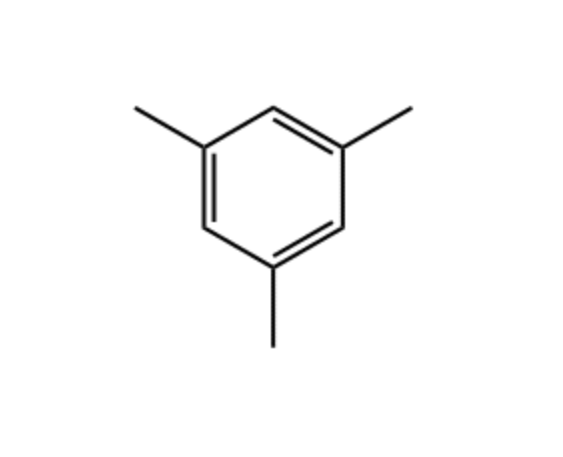
High Symmetry and Stability: Its molecular structure is highly symmetrical. The electron-donating effect of the three methyl groups increases the electron density of the benzene ring, making it chemically more stable than benzene and other xylene isomers. It is less prone to electrophilic substitution reactions (such as sulfonation or nitration) but more susceptible to reactions like Friedel-Crafts alkylation.
Physical Properties: It has a relatively high boiling point (~165°C) and flash point (~44°C) but remains a flammable liquid. It is insoluble in water but readily soluble in organic solvents such as ethanol and diethyl ether.
Solubility: It serves as an excellent solvent for many resins, dyes, and organic compounds.
Production Methods
Separation from Coal Tar or Petroleum Reformate: It occurs naturally in coal tar and certain petroleum fractions, but its concentration is low, making separation costly.
Chemical Synthesis (Primary Methods):
Acetone Method (Most Common): Acetone undergoes condensation, dehydration, and cyclization in the presence of catalysts such as sulfuric acid or ionic liquids to produce mesitylene. This is currently the primary industrial production process.
Toluene Disproportionation Method: Under specific catalysts, two molecules of toluene react to form a mixture of benzene and xylene, which includes a certain amount of mesitylene, though further separation is required.
Friedel-Crafts Alkylation Method: Using benzene or toluene as raw materials and methanol or chloromethane as alkylating agents, the reaction yields a mixture of multiple isomers.
|
Items |
Specification |
Results |
|
Appearance |
Colorless liquid |
Colorless liquid |
|
Density(20℃),kg/m3 |
862.0-868.0 |
865.1 |
|
Assay, ≥ |
98.00% |
98.83% |
|
(1,2,4-Trimethylbenzene), %≤ |
1.0 |
0.70 |
|
Saybolt Color, ≥ |
+25 |
+30 |
|
Sulphur content, ≤ |
5.0 |
<1.0 |
|
Conclusion |
Qualified |
|
Mesitylene is a high-value-added fine chemical intermediate with a wide range of applications:
|
Application Field |
Specific Use |
Description |
|
Organic Synthesis |
Synthesis of trimellitic acid/trimellitic acid chloride |
This is its most important downstream product. Trimellitic acid is a key monomer for producing high-performance engineering plastics (e.g., polyimide, polyester), high-temperature-resistant polymers, dyes, and plasticizers. |
|
|
Synthesis of 2,4,6-trinitromesitylene |
An explosive material, but with limited demand in the civilian sector. |
|
|
Synthesis of pharmaceutical and agrochemical intermediates |
Its symmetrical structure is often used in synthesizing symmetrical drug molecules or agrochemicals. |
|
Solvent |
Specialty solvent |
Used in electronic chemicals, high-end coatings, and resin reaction media due to its high boiling point, stability, and excellent solubility. |
|
Fuel and Additives |
High-energy fuel component |
Due to its high calorific value and stability, it can be used as an additive in jet fuel or as a high-energy fuel for special purposes. |
|
Other |
Chromatography reference standard |
Used as a standard reference material in gas chromatography. |
|
|
Metal extractant |
Its derivatives can be used for the extraction and separation of certain metal ions. |