


Enhanced Safety and Stability:
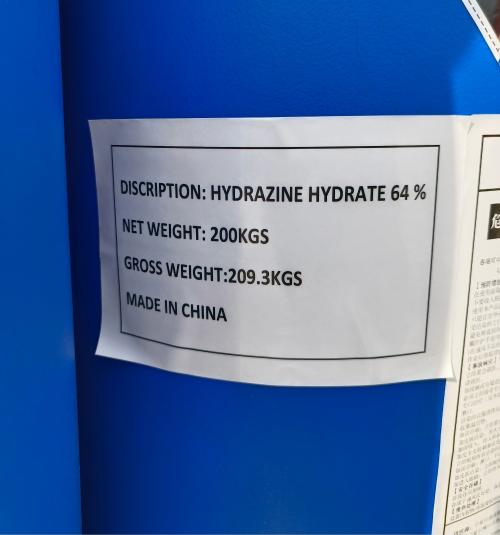
Lower Freezing Point: The freezing point of 64% hydrazine hydrate is approximately -51°C, while that of the 80% concentration is around -40°C. This makes the 64% product less prone to freezing in low-temperature environments, resulting in relatively more lenient storage and transportation conditions. This advantage is particularly significant in cold regions.
Reduced Volatility and Irritating Odor: The lower concentration leads to slightly lower volatility and a less pungent ammonia-like odor at room temperature compared to the 80% product, thereby slightly reducing immediate air pollution in operational environments.
Potentially Moderated Reaction Intensity: When reacting with certain oxidizers or during specific reactions, the lower concentration may provide some buffering against the initial intensity of the reaction, offering a slightly larger safety margin for industrial control.
Optimized Thermodynamic and Mass Transfer Properties:
In certain applications (e.g., as a reducing agent in aqueous-phase reactions), the 64% concentration may offer improved solubility and material mixing performance, helping to avoid localized intense exothermic reactions or side effects caused by excessively high concentrations.
For processes requiring precise dosing and slow addition, the lower-concentration product allows for smoother and more controllable feeding.
Economic Efficiency and Applicability:
In applications that do not require extremely high reducing equivalents, using the 64% product may be more cost-effective. The price per unit of active ingredient (pure hydrazine) is generally comparable to or slightly advantageous over that of the 80% product after conversion. Additionally, it can be used directly, eliminating the steps and risks associated with on-site dilution.
It serves directly as a specified-concentration raw material for certain processes, eliminating the need for user dilution and ensuring consistency and stability across batches.
|
INSPECTION ITEMS |
SPCIFICATION |
RESULTS |
|
Appearance |
Colorless and clear |
Colorless and clear |
|
Assay % (N2H4•H2O) |
≥64.00 |
64.69 |
|
Non-volatile matter % |
≤0.010 |
0.0030 |
|
Iron % (Fe) |
≤0.0005 |
0.000022 |
|
Sulfate % (SO4) |
≤0.0005 |
<0.0005 |
|
Heavy metals% (Pb) |
≤0.0005 |
<0.00048 |
|
Chloride % (Cl) |
≤0.003 |
0.001 |
1. Boiler Water Treatment and System Protection (The Most Critical and Classic Application)
Core Function: Serves as an efficient volatile oxygen scavenger and metal passivator.
Working Principle:
Oxygen Removal: Rapidly reacts with dissolved oxygen in boiler feedwater to produce nitrogen and water, fundamentally preventing oxygen corrosion.
Passivation: Under high temperature and pressure, it forms a dense, adherent magnetite (Fe₃O₄) protective film on carbon steel and other metal surfaces, providing ongoing corrosion protection.
2. Chemical Blowing Agent Production
Core Function: Acts as a key nitrogen source raw material for producing chemical blowing agents such as azodicarbonamide (ADC) and azobisisobutyronitrile (AIBN).
Application Features: Blowing agent manufacturers select the most suitable raw material concentration based on their specific synthesis process ratios, safety controls, and cost considerations. The 64% hydrazine hydrate is one of the widely used standard concentrations in the industry, offering stable supply and mature processing technology.
3. Agrochemical and Pharmaceutical Intermediate Synthesis
Core Function: Serves as a critical building block and reducing agent for constructing nitrogen-containing heterocycles (e.g., triazoles, pyrazoles, diazines).
Specific Applications:
Pesticides: Production of triazole fungicides (e.g., tebuconazole, difenoconazole), sulfonylurea herbicides, and neonicotinoid insecticides (e.g., imidacloprid).
Pharmaceuticals: Synthesis of anti-tuberculosis drugs like isoniazid, antibacterial drugs such as nitrofurantoin, and various cardiovascular and psychiatric medications.
4. Metal Treatment and Surface Processing
Core Function: Utilizes its strong reducing properties for metal purification, refining, and surface modification.
Specific Applications:
Precious Metal Recovery: Reduces and recovers gold, silver, platinum, palladium, etc., from electronic waste or catalyst waste liquids.
Electroless Plating: Acts as a reducing agent in electroless nickel or copper plating, enabling the deposition of metal ions onto non-conductive materials.
Metal Cleaning and Passivation: Removes oxides from metal surfaces and forms protective layers.
5. Other Fine Chemical Fields
Antioxidant: Used in polymer materials (e.g., rubber, polyamide) to prevent thermal oxidative degradation.
Polymerization Aid:Functions as an initiator or chain transfer agent in certain polymerization reactions.
Photographic Chemicals: Serves as a component in developing agents.